
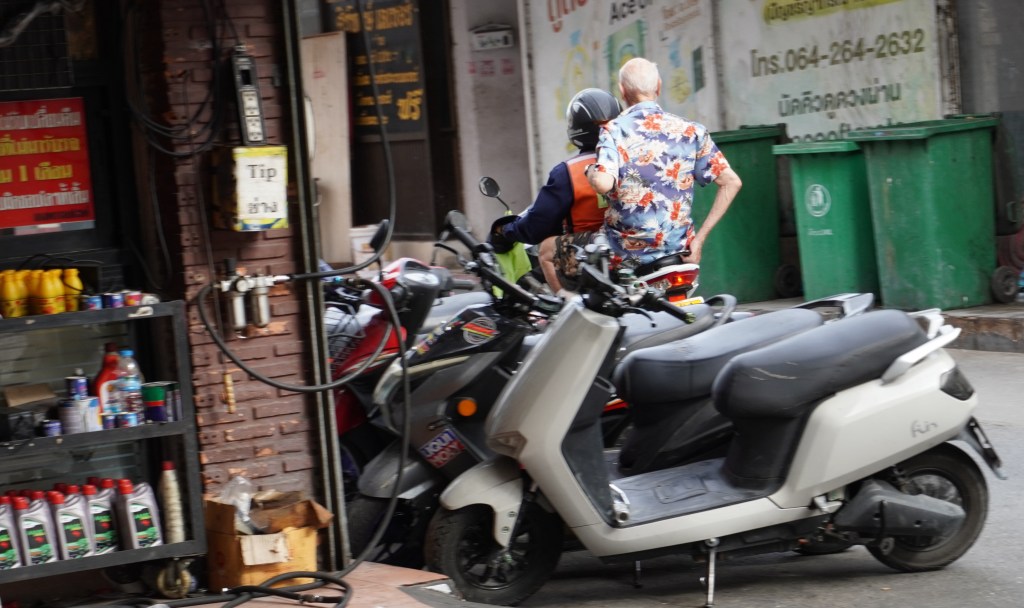
Spend five minutes beside almost any major road in Pattaya and one fact becomes obvious: motorcycles run this city. They slip through traffic, fill nearly every available parking space and transport everyone from tourists heading to the beach to working girls trying to earn their next paycheck.
For many Pattaya residents, a motorcycle is not a luxury or a weekend toy. It is the fastest and most affordable way to reach customers, buy groceries, make deliveries or avoid sitting inside a car while traffic moves at the speed of a hungover tourist looking for his hotel.
Motorcycles also support an entire working economy. Orange-vest motorcycle-taxi drivers wait near intersections and shopping areas, ready to move passengers across town. Delivery riders carry meals, packages and convenience-store orders. Other motorcycles are modified with sidecars, baskets and cargo racks, transforming basic scooters into mobile businesses and utility vehicles.
That convenience, however, comes with a serious cost.
According to the World Health Organization’s Thailand road-safety program, the country had an estimated 18,218 road-traffic deaths in 2021—an average of approximately 50 deaths every day. Motorcyclists accounted for 83.8 percent of those fatalities. Thailand’s estimated road-traffic death rate was 25.4 per 100,000 people, placing it among the highest rates in Asia.
Those are national figures, not Pattaya-specific numbers, but the risks behind them are visible on Pattaya’s streets every day. While photographing this story, I saw riders wearing quality helmets alongside riders wearing no helmet at all. I saw passengers riding unprotected, motorcycles squeezing between larger vehicles and groups of riders gathering at already crowded intersections.
The danger is not caused by one type of person. It is a combination of human decisions, crowded roads, vehicle condition, inconsistent enforcement and infrastructure that does not always provide motorcycles with enough safe space.
A 2026 study on reducing motorcyclist casualties in Thailand identified several continuing barriers, including inadequate infrastructure, uneven enforcement, cultural attitudes toward road safety, fragmented coordination between agencies and the limited use of available data and technology. In other words, telling riders to “be more careful” is not a complete safety policy.
Helmets remain one of the most immediate forms of protection. Thailand requires both motorcycle operators and passengers to wear them, yet compliance remains inconsistent. The WHO has reported that universal helmet use by drivers and passengers could potentially prevent thousands of deaths annually.
Safety also begins before the engine starts. Tires, brakes, lights and basic maintenance can determine whether a rider avoids a collision or becomes part of one. Safer motorcycles, properly fitted helmets, responsible speeds, better enforcement and road designs that anticipate human mistakes must work together. The WHO’s motorcycle-safety guidance emphasizes this broader approach rather than placing the entire responsibility on individual riders.
Pattaya is not going to abandon motorcycles, and it should not have to. They are too deeply connected to the city’s transportation, tourism and livelihoods. The goal should be making motorcycles safer without destroying what makes them useful.
Two wheels will continue moving Pattaya. The question is how many riders will make it home when the ride is over.
 Thai Life Chronicles
Leave a comment